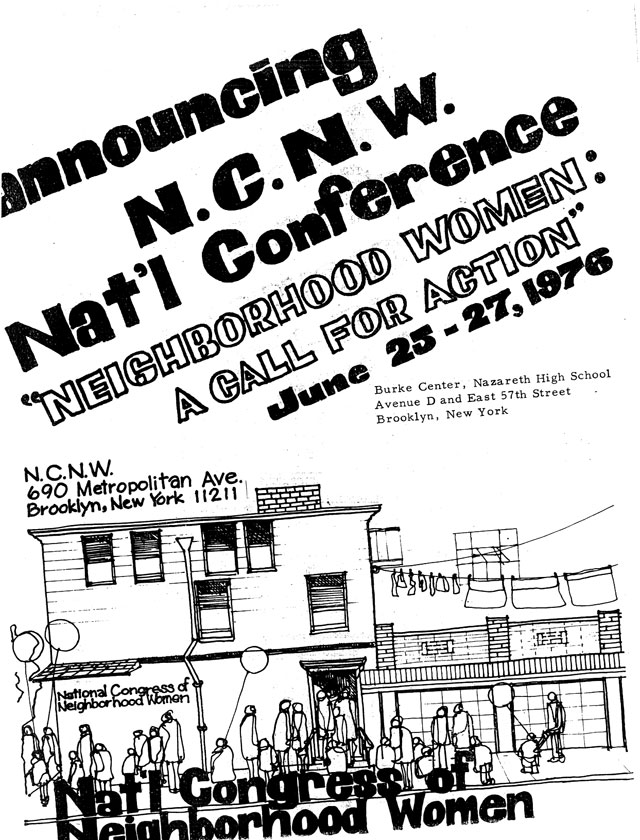
“For years we neighborhood women have been working to improve our communities. We have done it unrecognized, often unthanked, and almost always without the help we have needed to be truly effective… The National Congress Of Neighborhood Women wants to change that. COME TO OUR NATIONAL CONFERENCE AND SEE FOR YOURSELF!”
Flyer NCNW National Conference, Neighborhood Women a Call for Action, 1976
The National Congress of Neighborhood Women brought together, through their conferences, low income and working class women to share their experiences, knowledge and community development skills. In 1975, just a year after the NCNW’s founding, women leaders and neighborhood women affiliates from diverse ethnic, religious and racial backgrounds gathered at their first national conference. By 1978 the NCNW had celebrated six conferences, all of them based on the principle that women are fundamental to the social and economic development of the community. These first conferences became just the start of more than thirty years of celebrating conferences
1975 – First National Conference
The First National Conference of the NCNW became a vital link for communication and support for working class and low income women who had been seeking a space where their interests, needs and concerns were truly addressed. Women from Appalachia, the barrios of California, Texas and New York, the neighborhoods of Boston, Pittsburgh and small rural towns, like Pritchard Alabama, all gathered with the aim to have a unified national voice.
March 1976 – Second Conference “Knowledge for Whom: Education as Culture Shock”
“Knowledge for Whom: Education as Culture Shock” was a New York City conference that brought together educators and community residents to share ideas and programs designed for community based college programs for neighborhood residents.
June 1976 – Third Conference “Neighborhood Women a Call for Action”
The third national conference brought together over two hundred women from different cities in the United Sates. Workshops and panels dealt with issues of education, affirmative action programs for women, health services, employment, the media stereotyping of working class women, and women as community and political leaders. It also provided a forum for them to share their problems and successes as community leaders.
October 1976 – Fourth Conference “Neighborhoods ’76: Problems in Policy and Power”
The first Annual Alliance for Neighborhood Government was sponsored by NCNW and the Ethnic Neighborhood Action Center in Brooklyn. Conference participants developed strategies on housing, red-lining, neighborhood revitalization, shared community organizing and political outreach strategies.
December 1977 – Fifth Conference “Citizen Participation Conference”
The fifth conference was co-sponsored by NCNW and the Ethnic Neighborhood Action Center. Its purpose was to increase citizen participation in all government programs and agencies, particularly regarding allocation of funds through community development grants and CETA Title VI, and to provide mechanism for citizens to voice their concerns about social service cutbacks in the areas of programs for older adults and children.
June 1978 – Sixth Conference “National Planning Conference”
Representatives from NCNW affiliates groups across the country met in Brooklyn to plan for a 1979-1980 national conference. Working sessions were also developed around the roles and responsibilities of affiliates and headquarters in a time of intense program development and expansion and the growing sophistication of affiliate groups. Technical assistance, direct services and regional outreach as means for strengthening the network of working class women were emphasized.
Text Reference:
Concept Outline for Stabilization and Expansion of the National Congress of Neighborhood Women, 1978, National Congress of Neighborhood Women Records, 1974-1999, Sophia Smith Collection, Smith College, Northampton, Massachusetts. 9 pp.
Letter to Anchor Saving Bank, 1978, Box 112, National Congress of Neighborhood Women Records, 1974-1999, Sophia Smith Collection, Smith College, Northampton, Massachusetts. 1 pp.
Document on Brooklyn Conference, 1978, Box 112, National Congress of Neighborhood Women Records, 1974-1999, Sophia Smith Collection, Smith College, Northampton, Massachusetts. 2 pp.